



EN
inLombardia

Itinerary of Protestant Places

Discovering Bergamasque places linked to the Protestant Waldensian faith

Introduction

Starting point
Piazza Giacomo Matteotti, 27
Duration
1h 30'
Length
2 km
Suitable for
adults, seniors
Mode
on foot

The link between Bergamo and Protestantism is closer than it might appear at first glance.
An evangelical religious community has resided in the city for more than four centuries, and over time it has been an active participant in the economic, social and urban development of the area.

The earliest members of this community were Swiss from Glarus, Zurich and the Grisons: they descended to Italy via the S. Marco Pass, Valtellina, crossing Cornello dei Tasso and following the Via Mercatorum to the plains. They were mostly merchants active in the cotton and silk trade, the spinning of which was, for sixteenth-century Bergamo, an important source of income. Facilitated by the annual St. Alexander’s Fair and the climate of religious tolerance established by the Venetian Republic, in the 18th century these merchants moved permanently to the city, blending in with the pre-existing social fabric without renouncing their identity.
Their business acumen translated into economic success, which many reinvested in the textile industry, family residences and good works.
Various testimonies of this cultural and artistic enrichment remain, which will help you discover the center of Bergamo in a new light.

The starting point of this itinerary is the monumental building that perhaps best testifies to the fates and commitment of Bergamo’s Protestant community: Palazzo Frizzoni.

From Palazzo Frizzoni to Via Sant'Orsola

Leg duration
20'

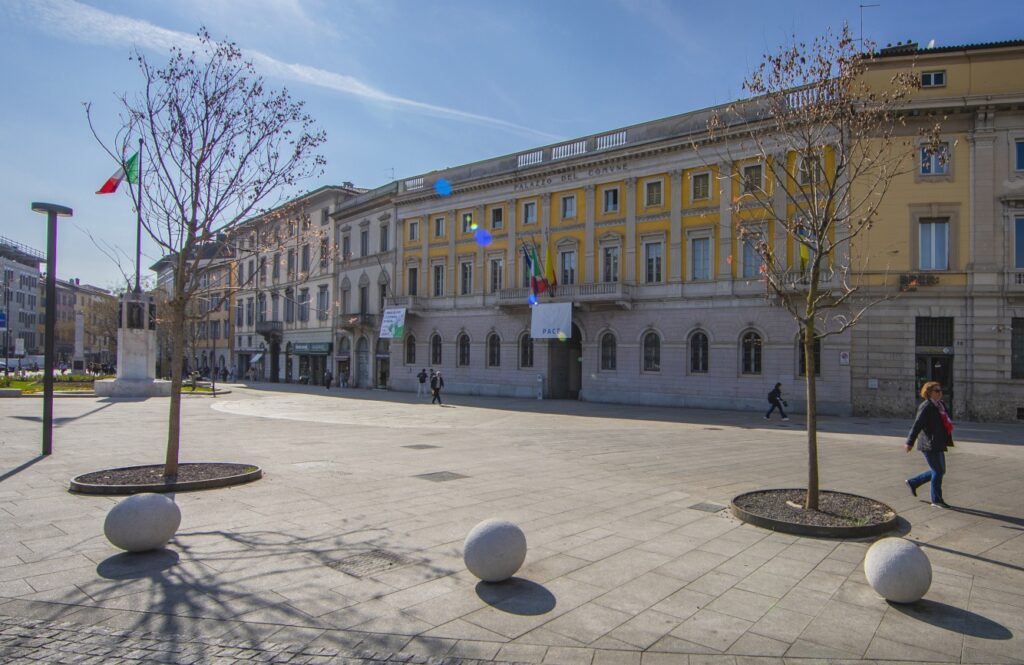
Built in the years 1836-40 at the behest of Enrico Frizzoni, the last member of one of the city’s leading Waldensian families, Palazzo Frizzoni is a magnificent Neoclassical-style building now housing Bergamo’s City Hall.
Inside are wonderfully decorated rooms and an art gallery containing some 80 paintings.

Two streets equally linked to Waldensian history flow onto Matteotti Square, moreover: these are Via S. Orsola and Via Borfuro, where the first “in house” churches of Bergamasque Protestants were located, first in Via Sant’Orsola at the Bonorandi family, later in Via Borfuro at the Mariton family, related to those Blondels to whom Enrichetta, Alessandro Manzoni’s wife, would be born.

To follow the route, take Via Borfuro and, when you reach the end, turn left to take Via Sant’Alessandro.
After about 120, you will find Via Sant’Orsola on your left, which will bring you back to the vicinity of Palazzo Frizzoni.
From the Sentierone to Viale Roma

Leg duration
15'

Keeping Palazzo Frizzoni on your left, continue straight ahead and walk along Piazza Matteotti until you reach the crosswalk. Here turn left to take Viale Roma: after about 130 meters, on the left, at number 2/a you will encounter another important building, linked in this case also to current history: the Temple of the Evangelical Community.
Usually open on Sunday mornings for religious services, it is a fine example of 19th-century neo-Renaissance architecture.
Via Tasso and Borgo Pignolo

Leg duration
50'

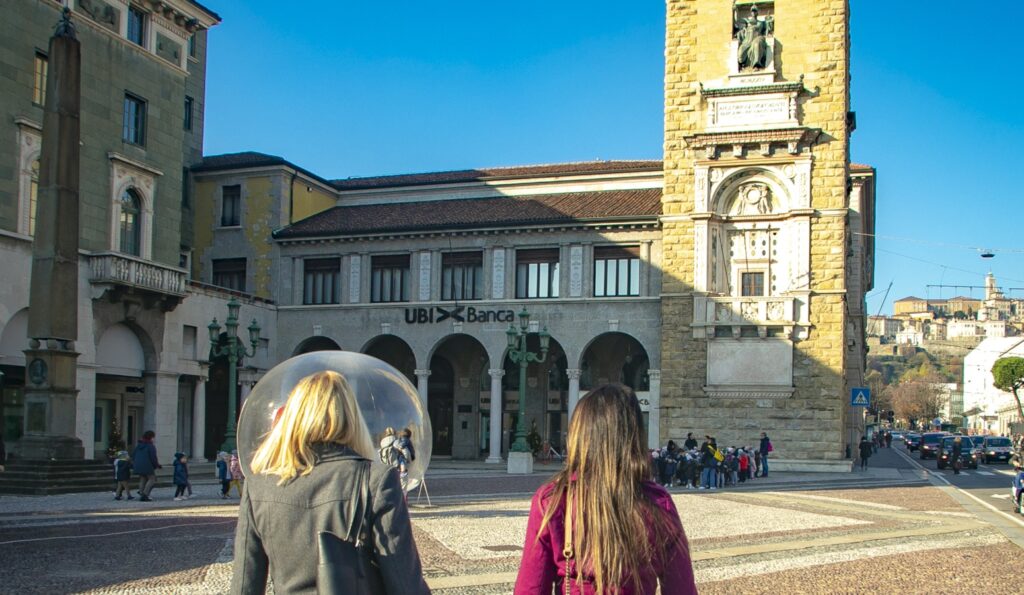
To reach the last stages of the itinerary, take the most scenic route by taking Via Petrarca, which is almost opposite the Temple and runs alongside the monumental Piazza Libertà. Keeping to the side of the Bank of Italy, after a few steps you will be able to access the renovated Piazza Dante, which flows onto the Sentierone through a splendid columned portico. From here, go right and walk down Via Tasso to number 55, where you will find the Protestant Cultural Center.
Also located in the same building is the Library named after Gerolamo Zanchi, a scholar of Bergamascan origin who was one of the leading representatives of the European Waldensian community.

The neighborhood is particularly relevant to the history of the local Waldensian community because, as early as the 16th and 18th centuries, it recorded, along with Borgo Pignolo, the highest concentration of residents of the Protestant faith, mostly Swiss.
It was in Via Tasso that the headquarters of the area’s first trade association was founded – precisely by the Waldensians – and it was in Borgo Pignolo, one of Bergamo’s most beautiful and ancient villages, that another private Waldensian church was located.

For a complete overview of Bergamo’s Protestant sites, 140 meters further on, still on the left side, you will encounter theformer CaprottiPalace and Park, commissioned in the 1800s by the family of the same name of industrialists from Brianza, who were in close relations with the Waldensian community (as evidenced by the creation of the Caprotti Zavaritt retirement home in Gorle, founded in 1980).
In addition to admiring the building’s fine decorations, thanks to the large garden you can also enjoy a green break in the heart of the city, among ponds and swans.


Italian Ministry of Tourism fund in favor of municipalities with cultural, historical, artistic, and scenic vocations, in whose territories are located sites recognized by UNESCO as World Heritage Sites.

The Minister of Tourism together with with the Minister of Economy and Finance, following an agreement reached at the Unified Conference, has adopted a measure establishing the “Fund in favor of Municipalities with cultural, historical, artistic, and scenic vocations, in whose territories are located sites recognized by UNESCO as World Heritage Sites” (hereinafter referred to as the “Fund”).

The aim is to support the recovery of the tourism sector, particularly affected by the crisis generated by the Covid-19 pandemic, in municipalities characterized by a marked tourist-cultural vocation. The initiative is aimed at and supports Italian cities that are part of the UNESCO Creative Cities Network. The establishment of the aforementioned Fund primarily responds to the objective of revitalizing the Italian tourism sector by supporting the development of projects aimed at enhancing the cultural heritage in cities where the presence of sites listed on the UNESCO heritage list is a determining factor in attractiveness and tourism competitiveness.

The interventions consist of initiatives related to digital tourism promotion and valorization tools, tourist itineraries, tourist marketing projects, as well as construction, structural, or plant works and setups aimed at increasing tourism enjoyment and attractiveness.
The fund has a total financial allocation of 75 million euros. The amount is distributed as follows:

  • 58.8 million for “Municipalities with cultural, historical, artistic, and scenic vocations” in whose territories there are sites recognized by UNESCO as World Heritage Sites;
  • 4.9 million for Italian municipalities that are part of the UNESCO Creative Cities Network;
  • 9.8 million for tourist enhancement interventions in the city of Rome;
  • 1.5 million for assistance activities to municipalities (e.g., verification of proposed projects, reporting, and monitoring) and for the creation and management of the dedicated computer platform for the incentive.

Guidelines for communication and advertising of the interventions have been developed to facilitate the promotion of projects funded. An operational tool aimed at providing beneficiaries with elements to promote and disseminate the results of funded projects. Communication and advertising, in addition to being obligatory, are above all an opportunity for beneficiaries to showcase the projects implemented and the investments made through access to funding granted by the Ministry of Tourism.

INNOVATIVE TOURISM IN A JOURNEY AMONG VENETIAN DEFENSE WORKS

Agenzia per lo sviluppo e la Promozione Turistica della Provincia di Bergamo scarl received funding of xxx euros from the Italian Ministry of Tourism to implement the project described below.

Project Abstract

The project “Innovative tourism in a journey among Venetian defense works” is based on a strategy that spans cities belonging to the UNESCO Site, aimed at increasing tourist presence by at least 5% compared to the 2019 benchmark, reaching a value of at least 3,248,511 tourist presences. The strategy of the tourism enhancement project is based on creating an itinerary among the three cities, with particular attention to the international public but also to the national public from the most distant regions, offering an original sense to the visit of the territories. The target demand includes cultural tourists, interested in original interpretations of places, slow tourists who want to discover the territories connecting the three cities, and tourists no longer involved in work activities who can visit the three cities sequentially even on less crowded days.
Through various integrated actions, the following segments of demand are targeted:

  1. Local tourism: Lombards/Venetians/Emilians able to make a day visit. This target, although interesting for our cities, is difficult to monitor as it does not fall within the count of presences, which corresponds to the number of overnight stays, representing the main indicator (Istat data);
  2. National tourism: Italian visitors who stay at least one night;
  3. European tourism: European visitors who stay at least one night;
  4. Intercontinental tourism: Visitors from North America, South America, the East, Israel, the Arab Emirates who stay at least one night.

To achieve the set objectives, it is considered fundamental to prioritize expenses for the production of promotional content dedicated to visitors who are about to choose their destination, as well as to invest in infrastructural interventions focused on accessibility and reception. The following strengths are identified as the basis for the tourism enhancement strategy:

  • Promotion of direct activities of the UNESCO sites and those related to it, which becomes the engine for the recovery and development in a cultural-touristic key of the cities;
  • Segmentation in the above-described audiences to which the intervention is addressed, that increases the tourism potential of the cities as it shows consideration and monitoring of the needs and characteristics of each target;
  • Use of the portal www.Italia.it, which will become the reference point for all actions related to the project and the showcase for past, present, and future activities;
  • Appeal to the population and tourists for active participation, which can transform the cities into a laboratory of ideas and innovative experiences aimed at increasing attractiveness and tourist presences.

Within the project, a joint promotion of the serial site will be activated, leading tourists to discover the three cities as a whole.
The tourism sector can benefit from the advantages resulting from the expected increase in presences and an increase in the average length-of-stay, thanks to a renewed interest in the activities communicated, proposed, and encouraged through innovative digital tools. These tools act as aggregators of cultural proposals, related to each other due to the same cultural spirit, originating from the values at the basis of the UNESCO site recognition. The birth of new businesses linked to the development of non-hotel realities and connected to the creation of experiences that have UNESCO values as the element of originality is foreseen.

The unified communication and promotional model aims to stimulate the creation of tourist products and visiting experiences that cut across the three cities, a segment not yet perceived by entrepreneurial activities as a source of additional attractiveness. Furthermore, the development of tourist experiences that blend UNESCO themes with other tourist products offered by each city will be incentivized, with exportable formats, with a multidisciplinary approach to tourist offer implying the development of new skills.

The presence of tourist experiences consisting of a varied range of elements becomes attractive for the international tourist who finds a way to experience multiple aspects of the national tourist offer without having to build it themselves. Moreover, the Integrated communication plan presupposes the development of common languages and coherent representations by the entrepreneurial realities of the three cities, generating a unique, recognizable, and unifying brand.
The project expects an increase in the number of specialized tourist guides and an evolution of the visiting service that includes new itineraries and modes of fruition oriented also to multimedia products.

Communicating the product, the UNESCO sites as well as their values, but specific in the enjoyment of the single component, in its innovativeness compared to the current representation of the three cities, expands the perceived offer.
It therefore contributes to attracting additional tourist flows compared to those currently choosing the three cities of the site. UNESCO represents a key element of attractiveness in some foreign markets. The audience attracted by visits to UNESCO sites is sophisticated in the enjoyment of experiences and detached from traditional seasonal contexts.
The discovery itinerary of the three cities through the UNESCO narrative invites slow fruition, with increased stays, and intercepts sections of the public free from work activities.

Thanks to this project, Bergamo, Peschiera del Garda, and Palmanova will activate for a joint promotion, leading tourists to discover the three cities as a whole. The promotion will work towards increasing tourist flows towards the individual cities and, in each of these, towards the other two. An intervention that will increase flows to the individual sites, also increasing the average length of arrivals. The enriched tourist offer and greater promotion of the historical asset will also lead to a deseasonalization of arrivals.

INTERVENTIONS

Innovative emotional video
Production of an emotional video with cuts of different durations, as a privileged promotional tool that will be adapted both for different social channels (YouTube, Meta, TikTok, etc.) and for use in offline environments (for example, LED walls/screens present in airports). The video will be dubbed in various languages (English, French, German, Spanish, Portuguese, Polish).

New web platform
The platform, through API management software, ensures bidirectional exchange of information with relative updating. When possible, the data will be updated in real-time; otherwise, the update frequency will be communicated. Bidirectional connection via API will be made possible by:

  • API with content link: for the enjoyment of digital content shared by operators such as images, videos, articles, APIs with links to recall the resource (content) present within the Operator’s CMS and presented by the TDH;
  • API with content: for the direct enjoyment of digital content shared by the above operators transmitted directly to the end user by the DMS;
  • Information transmission and/or reception APIs: for the exchange of information between TDH and Operator.

The ontological properties of the site’s contents will be adapted.

Realization of time travel experiences
Creation of visit paths consisting of points where spherical 360° videos can be viewed with reenactors allowing “time travels”. At certain points in the individual cities, markers (QR codes) will be installed that will allow visitors to access streaming from their smartphone (without downloading any apps) to immersive videos that will reproduce scenes of war or popular life during the time of the Serenissima or the main historical periods of the cities. Furthermore, the creation of a series of points where visitors can interact with virtual narrators is planned: by framing a QR code, tourists will be able to access videos, multilingual, during which actors will impersonate historical characters and narrate events, stories, and legends of the places of interest, guiding the visitor to the discovery of the transnational site.

Photographic service realization
Realization of photographic services in the three cities in the four seasons, capable of promoting the transnational site using the images made both on different social channels and on the tourist promotion sites of the three cities. The services include the use of different models of diverse ethnicities representing tourists and their emotions in visiting different attractive sites.

Press blog tour
Organization of blog tours and press tours to promote the visit of the three cities.

Influencers
Involvement of influencers (even very vertical ones) to promote the visit of the 3 cities.

Online advertising
Google display and search, Meta, TikTok.

B2B Marketing
Identify B2B marketing strategies to implement actions for an active community.

Updating tourist promotion sites
New engineering, updating, and technological adaptation of the tourist promotion sites of the three cities, with particular reference to dedicated sections in the three portals to the transnational site and to the site and the Venetian Fortress site with integration and interoperability with italia.it.

Infopoint repositioning
Repositioning and new setup of the info-point with a dedicated area to the UNESCO site (Visitor center) with the production of large panels, videos, interactive totems illustrating the three cities and the entire transnational site. The multimedia contents on the UNESCO site can also be used to implement existing Infopoints in other cities, dedicating a specific section to the presentation of the UNESCO site.

Contact us

Do you want more information?

Privacy policy(Required)
Newsletter

VisitBergamo Gift Card

This site is registered on wpml.org as a development site.