



EN
inLombardia

Accessible itinerary in the historic center of Clusone

Route statistics

Average travel time
1h 30'
Length
1.5 km
Positive elevation gain
Technical difficulty
medium
Negative height difference
Maximum altitude
Minimum altitude
Route type
ring

What to see in Clusone

In Bergamo’s Magnificent Valleys, art, nature and history intertwine to give you days of wonder.
In the Seriana Valley, the
ancient village of Clusone holds unique monuments: traverse its historic center following the itinerary we suggest, and walk the cobblestone streets that once saw illustrious figures such as Giuseppe Verdi stroll through, visiting ancient churches, museums and an astronomical clock that has been working flawlessly since 1583.
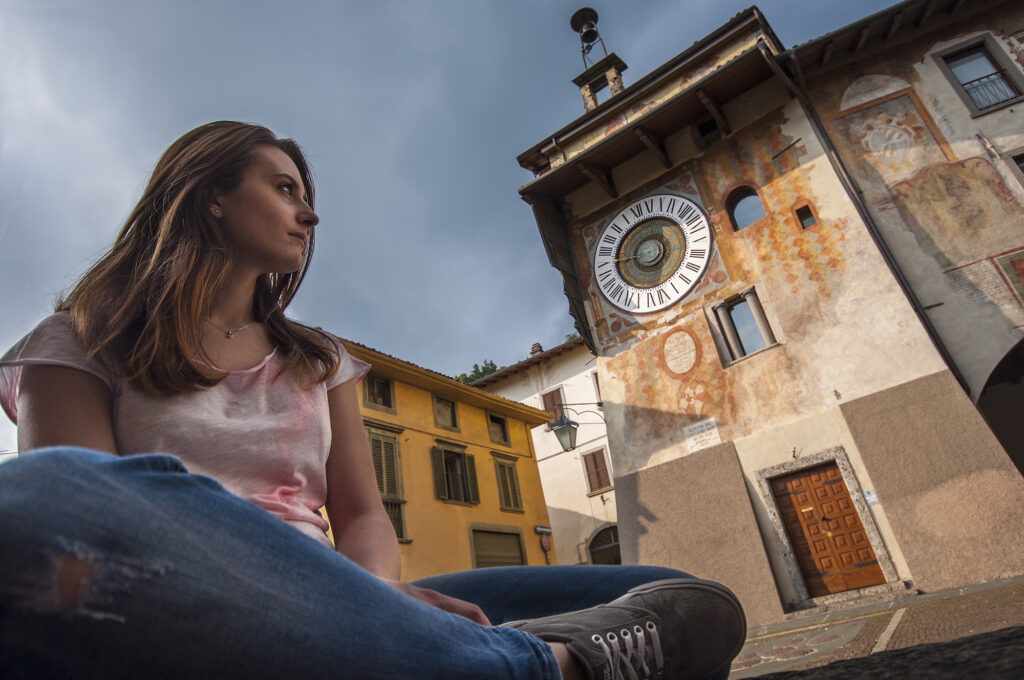
Clusone

Technical details

Ranking
Suitable for devices
Maximum slope
Paving
asphalt, porphyry, cobblestone
Toilet facilities
Orientation or informational signage
both, designed for people with disabilities Presence of trees or areas of shade: streets in shade depending on time of day; presence of historic arcades
Fountains for drinking water supply

Accessible route

The route is equipped with information accessible to all, also to people with visual and hearing disabilities, thanks to the new signage created as part of the S.T.A.I. Project (2023) in collaboration with Promoserio, the local development agency dedicated to promoting tourism in the Seriana and Scalve valleys.
At each point of interest you will find descriptive panels, equipped with qr codes that will allow you to learn more about the characteristics and events of each monument, in text format, audio guides, LIS videoguides for the hearing impaired, audio descriptions for blind people, as well as augmented reality animations dedicated to children.

S.T.A.I. – Services for Accessible and Inclusive Tourism – is a project funded by the Presidency of the Council of Ministers and the Lombardy Region, with the aim of proposing a model of inclusive tourism to be developed in the lake and mountain territories of Bergamo and Brescia.
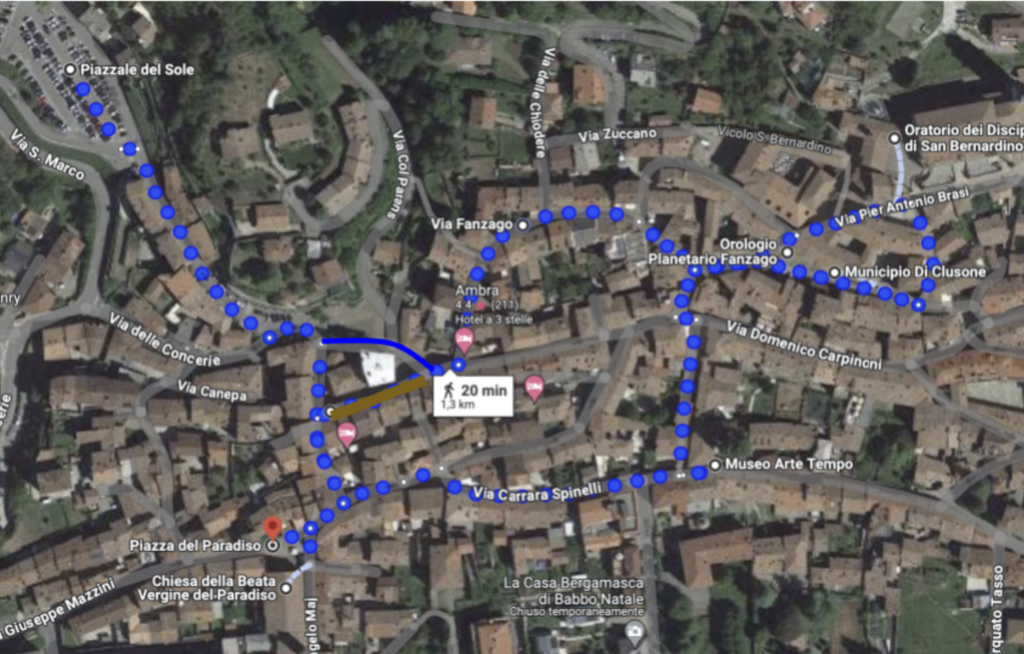
Getting downtown

Time
5'

You can easily reach Clusone by driving along the SS671 state road, which connects Bergamo to the Seriana Valley.
When you arrive in town, you will find ample and convenient parking in the upper part of the center, at the
Piazzale del Sole 33 St. Mark’s Street.

Exploration of the Historic Center

Once parked, leave the square behind and skirt the houses with terraced gardens, continuing on Via San Marco to enter the built-up area, among typical bars and stores.
After about 100 meters, at the fork, continue straight ahead and then turn right onto Via Marconi.
At the end of the street, turn right again and you will find yourself in the small but picturesque Piazza del Paradiso.
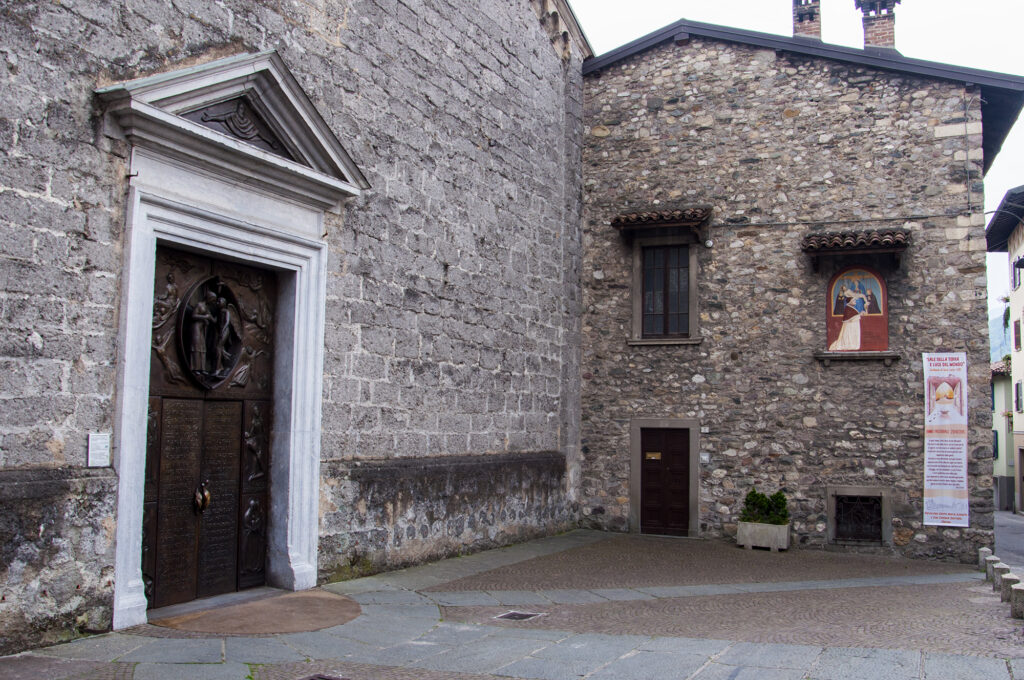

Church of the Blessed Virgin of Paradise

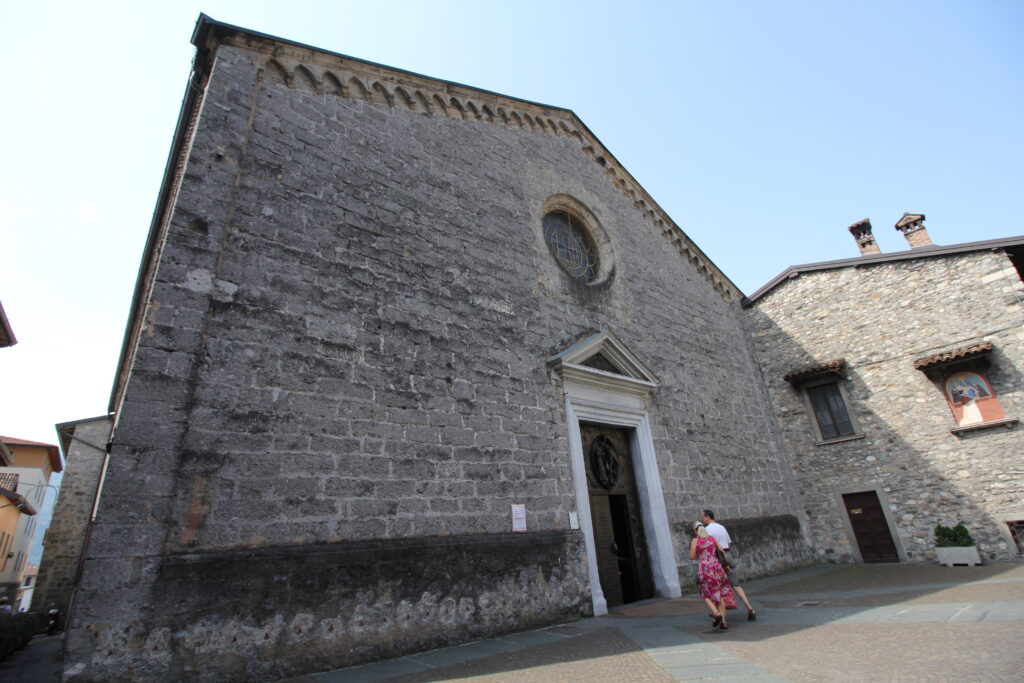
Here you meet the first historical point of interest: the Church of the Blessed Virgin of Paradise, erected in 1495.
Inside the building, externally simple with its facade of local stone, vividly colored works are preserved; the most significant is undoubtedly the 15th-century fresco depicting the
Our Lady of Sorrows, to which the town is very attached.
Not to be outdone are the altarpieces painted by the Clusonese Carpinoni, Cifrondi, Galizzi and Brighenti, flanked by the
Allegories of Faith, Hope and Charity by the sculptor Andrea Fantoni (17th-18th cent.).
At the Art Time Museum

Time
20'

To continue, turn your back to the church, retrace your steps for a stretch, and reach the small Piazza Pietro Antonio Uccelli.
Continue straight ahead, keeping to the right, to take Carrara Spinelli Street.
After 140 meters you will reach two more important monuments: the
Museum Art Time and Palazzo Carrara Spinelli.
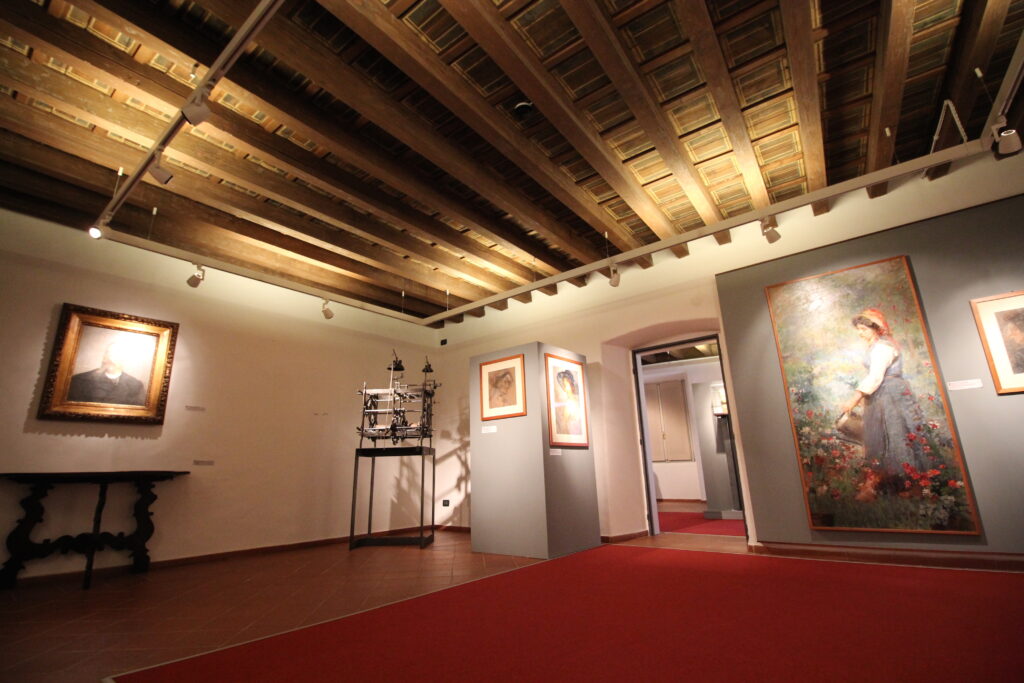
The former, housed in the rooms of the 17th-century Palazzo Marinoni Barca, display works by mainly Clusonese artists, donated by the Sant’Andrea, Querena, Trussardi Volpi and Nani families.
Among the most valuable works, don’t miss the canvases by Bergamo-born Giovan Paolo Cavagna and Palma il Giovane (from the Suardo collection) and two sculptures by Giacomo Manzù, who lived in Clusone during the war period.
In the adjacent garden, the Blue Ribbon Park, stand three centuries-old redwoods included in the list of monumental trees of Italy.
The perfect place for a relaxing break!
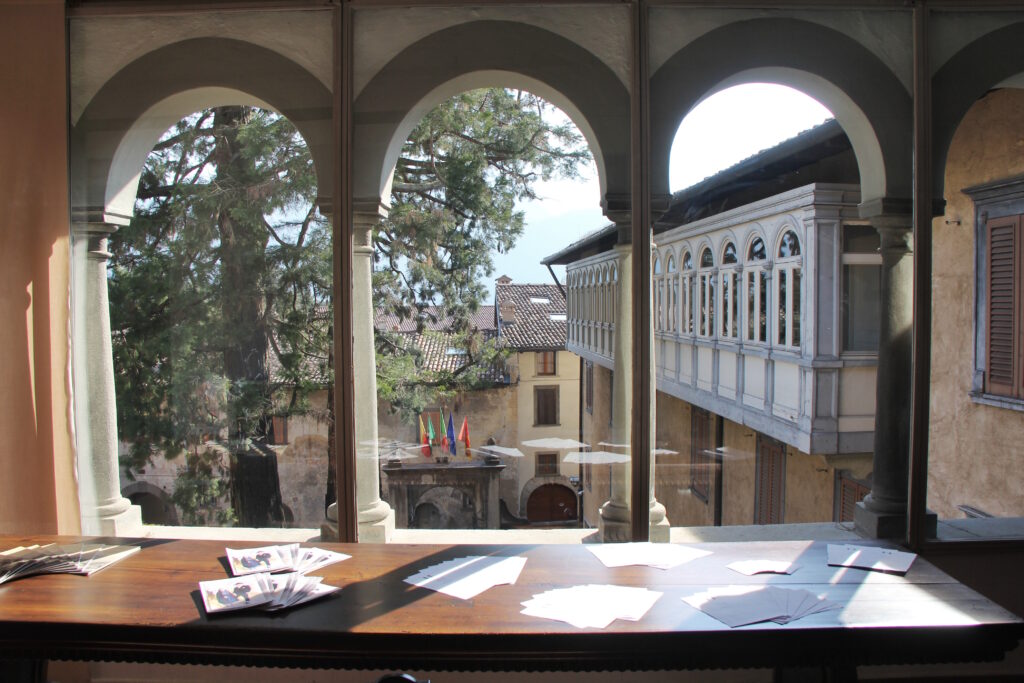
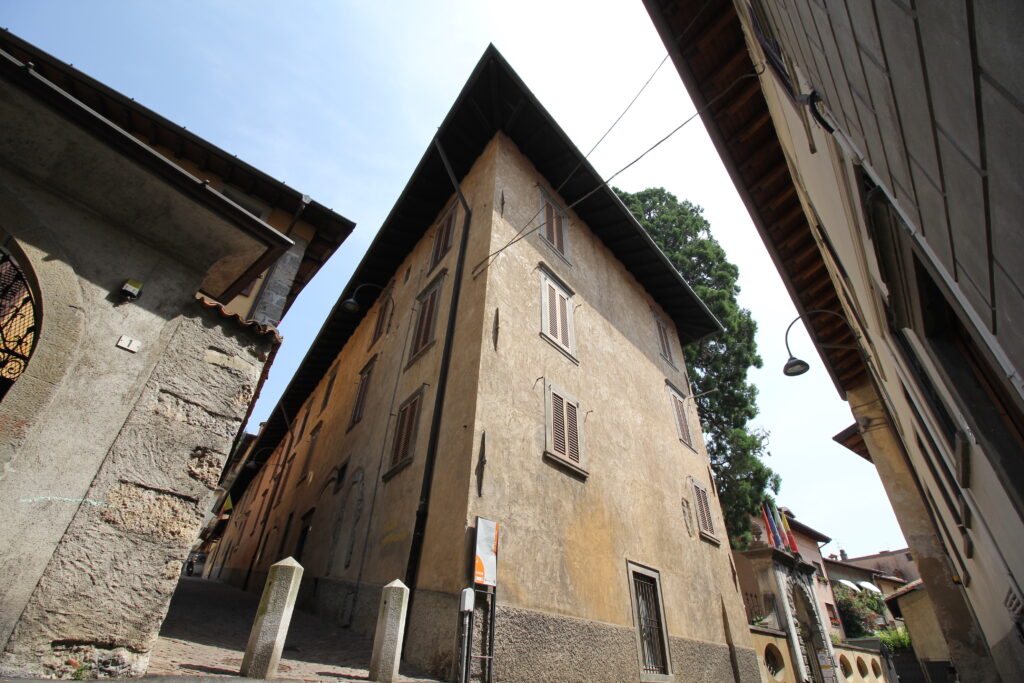
Opposite stands Palazzo Carrara Spinelli, long owned by the family of the same name, which became a cultural salon in the 19th century thanks to Countess Clara Carrara Maffei and hosted such illustrious figures as the composer Giuseppe Verdi and the literary politician Carlo Tenca.
Clock Square

Time
20'

To continue the route, take the passageway to the left of the museum and walk up the slight incline to Marinoni Square.
At the end, at the intersection, continue straight ahead to reach
Clock Square.
Questo è il cuore della città – e una passeggiata a Clusone non può non far tappa all’
Fanzago Clock!
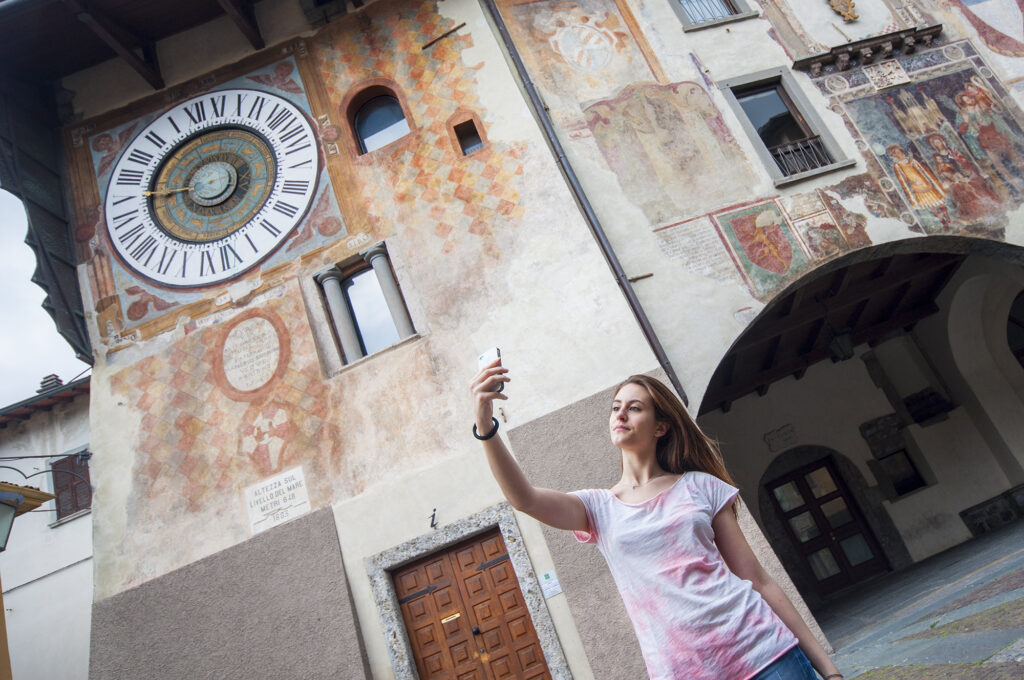
Set in a mighty tower, the Clock is a masterpiece of Renaissance ingenuity and engineering.
Its unique hand indicates not only the hour, but also the day, month, zodiac sign and moon phase of a precise moment, and this with the same parts it had at its inauguration in 1583.
It has been hand-loaded every day since then.
The author of this masterpiece is Pietro Fanzago, a member of a family of foundrymen, architects and engineers active in Clusone since 1360.
The presence of this complex and expensive construction testifies to the importance of the town at the time of Venetian rule, a period characterized by a great wealth of trade between Italy and northern Europe, for which Clusone was excellently situated.
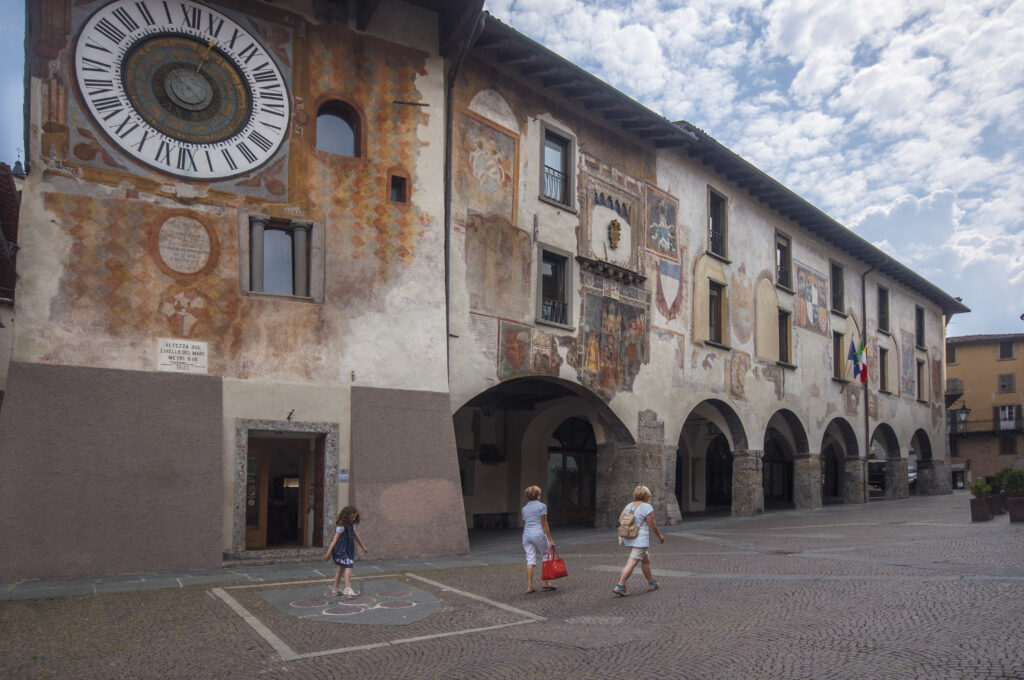
The tower that houses the Clock is part of theMunicipal Building, the construction of which dates back as far as the year 1000.
Architecturally severe in form, it is lightened by the presence of six stone arches and the frescoes that decorate its entire south wall, paintings that narrate important events in the history of the village and the surrounding area.
A curiosity?
The rampant catbird in red shield that appears in various areas is the weapon of the Upper Seriana Valley community.
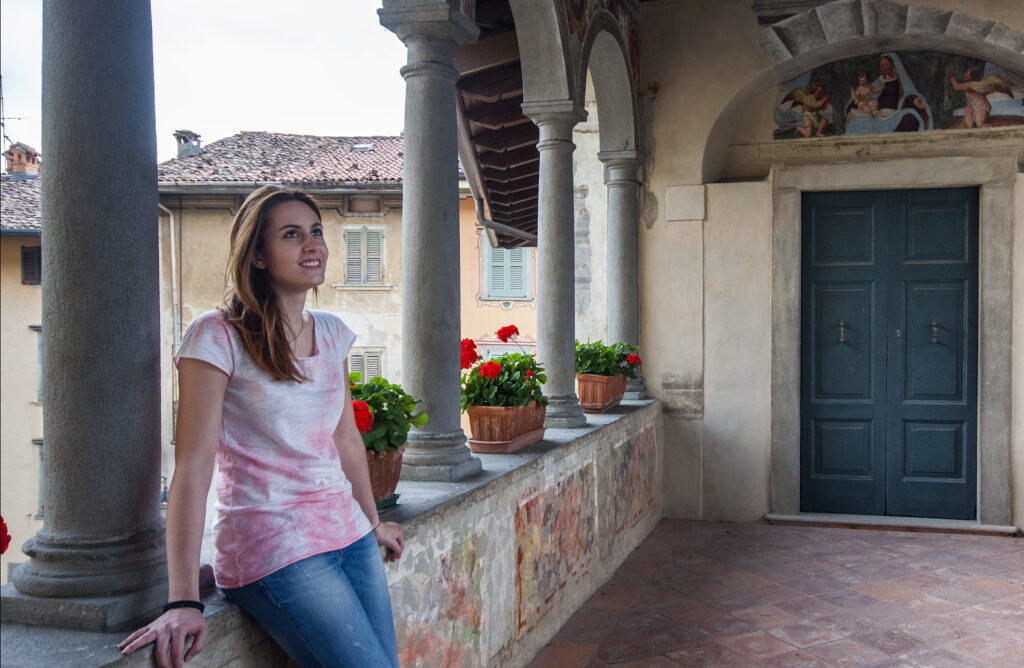
In the inner courtyard, accessible by walking along the portico from the Clock Tower to the end and turning left, you can discover other testimonies full of charm, such as the carved portal, the airy loggia above it and what remains of other splendid frescoes.
At the Basilica of St. Mary of the Assumption

Time
20'

Another special stop awaits you now: as you leave the town hall on Piazza Sant’Andrea, turn left onto Via Ruggero Viti and after about 50 meters a magnificent curving staircase will stand out before you.
It is the most beautiful of the three monumental entrances to the
Basilica of Santa Maria Assunta, which has towered over the town with its majestic forms since the 17th century.
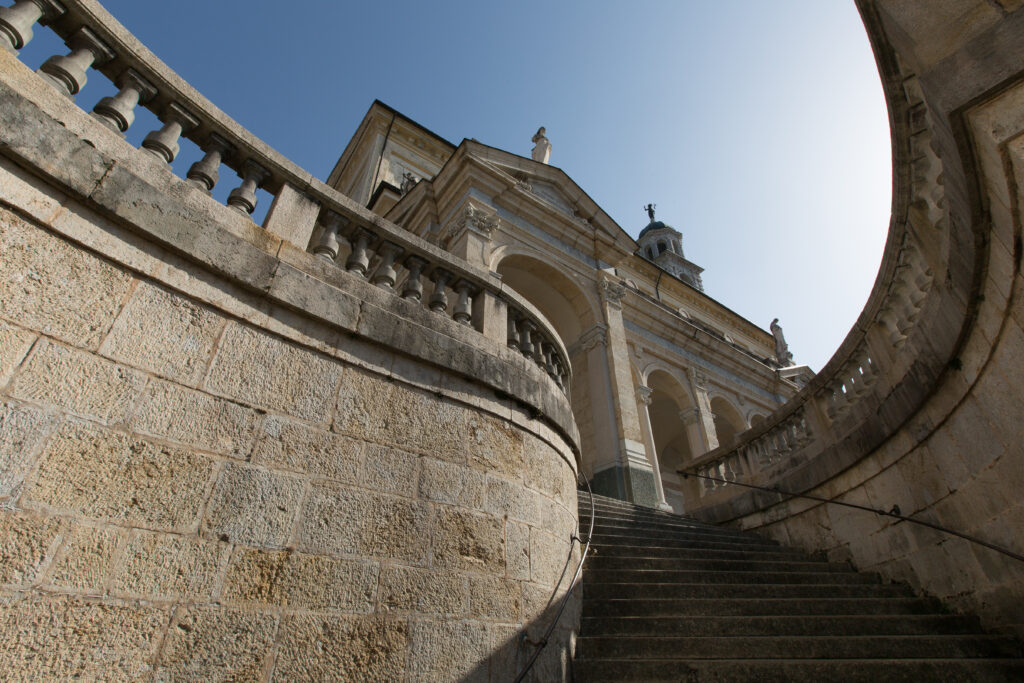
At the top of the steps, you will find yourself under the magnificent loggia flanking the church, built in 1984 to a design by Virginio Muzio.
Inside the basilica are frescoes by Bernardo Brignoli (nave and apse), canvases by Antonio Cifrondi depicting the
Last Judgment, l‘Coronation of the Virgin, Musician Angels e Jesus in Gethsemane just to name a few, the Our Lady of the Rosary (1730) by Andrea Fantoni and a 20th-century Stations of the Cross signed by sculptor Cesare Zonca.
The bell tower is located northeast of the church and is more than 66 meters high.
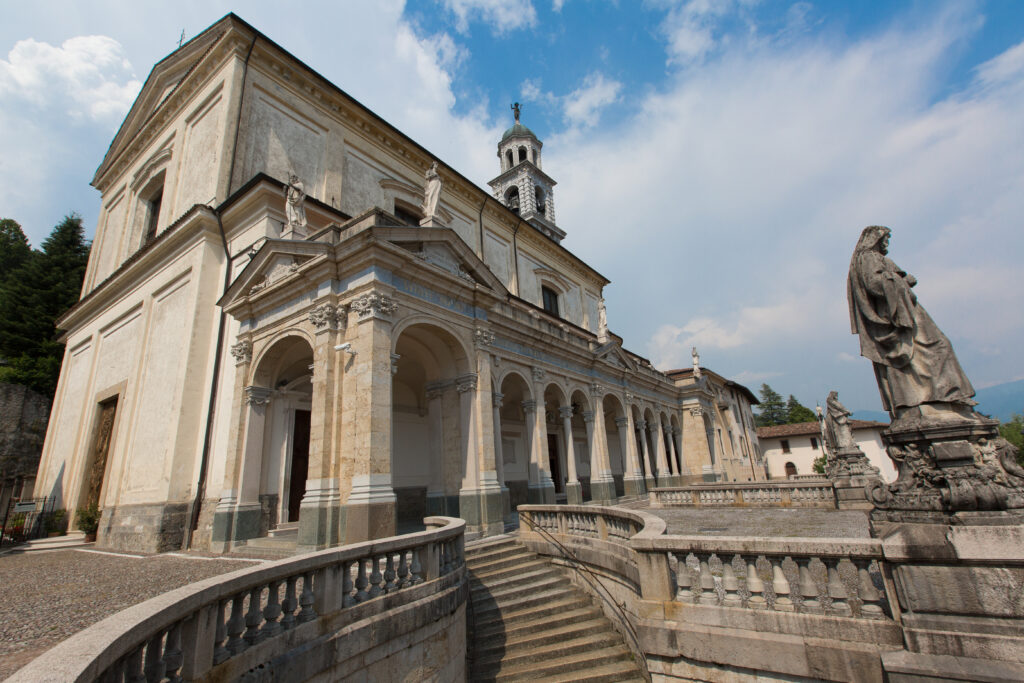
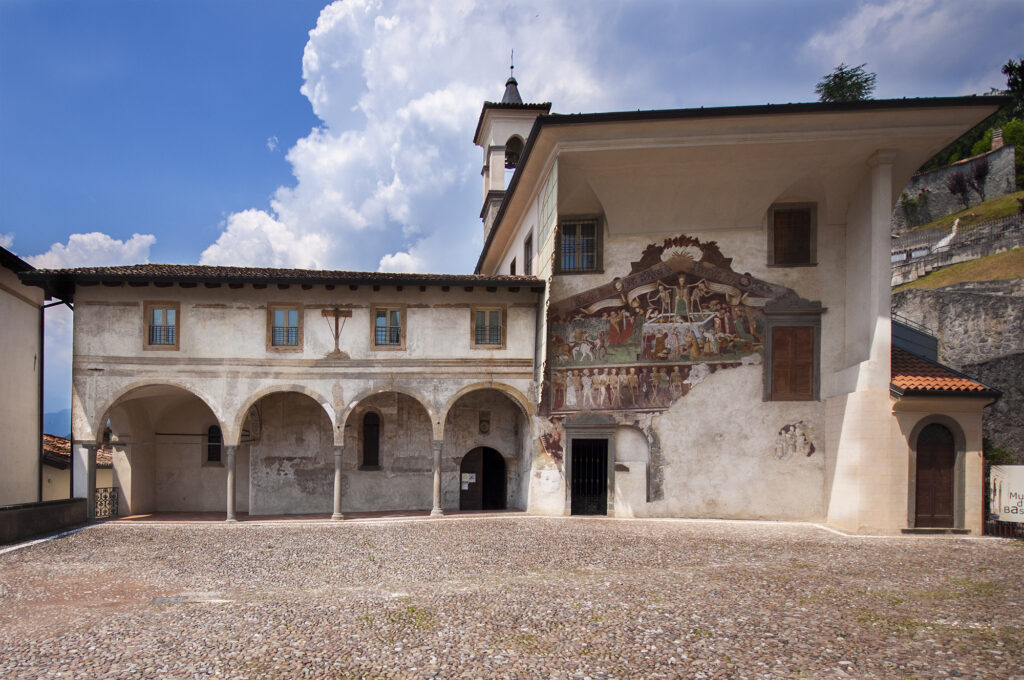
The wide space of the churchyard, raised and decorated by a balustrade with four statues of Evangelists, gives access to another Clusonese masterpiece: theOratory of the Disciplines.
Perfetta dimostrazione del fermento culturale e artistico del medioevo seriano, l’edificio vide posare la sua prima pietra nel Trecento, periodo di cui sopravvive la sola porta d’ingresso ad arco.
L’aspetto odierno risale largamente al Quattrocento, quando la confraternita dei Disciplini (che qui aveva sede) lo ampliò e dedicò a san Bernardino da Siena.
All’esterno potrai ammirare il
Triumph of death and the Dance Macabre by the Clusonese Giacomo Borlone de Buschis, who inside painted the Life of Jesus with the Crucifixion.
Sempre all’interno, sulla volta del presbiterio otto edicole esagonali sono affrescate con i
Prophets.

Also not to be missed is the magnificent panoramic view that the terrace offers of the city and the surrounding valley.
Toward Rock Square and back

Time
25'

You have almost reached the end of the recommended route.
To conclude it, go back down Brasi Street and, leaving the steps behind, proceed to the right to take Giudici Street.
Continue straight through ancient palaces, cloisters and walls until you return to Piazza dell’Orologio and, from here, take the first right,
via Fanzago.
Alla fine della strada, dopo uno sguardo sulla Clusone più
slow and secret, you will find yourself on Lattanzio Querena Street, enlivened by numerous stores and typical establishments.
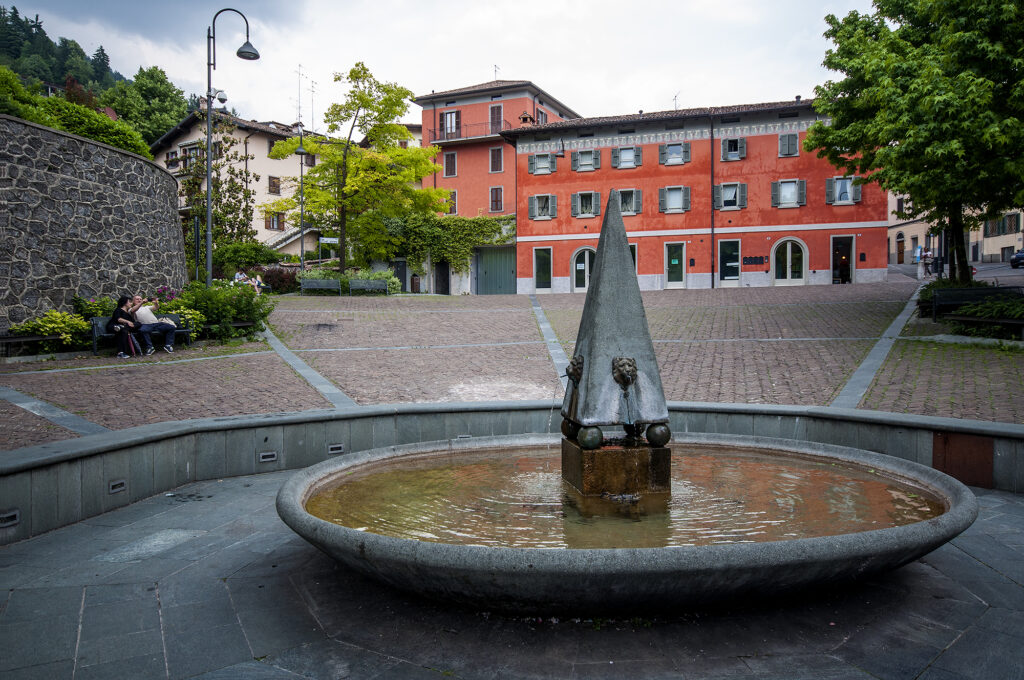
Turning right, take the passage to Piazza della Rocca for a look toward Clusone’s greenest neighborhood.
Continuing straight ahead, you will again meet S. Marco Street and, from there, you can return to the parking lot.
Other available parking spaces can be found at 2 S. Narno Street, behind the Basilica of S. Maria Assunta; at Mazzini Street, Manzù Square, Gusmini Street, and Roma Street, the latter being further downstream than the one recommended in the opening of the itinerary.

If you choose one of these parking lots, or if you reach Clusone by public transportation (streetcar T1 from Bergamo to Albino, then bus line S with drop-off on via Dante) you will start the route from a different area, but don’t worry: you can still get your bearings thanks to the maps of the center placed nearby.


Italian Ministry of Tourism fund in favor of municipalities with cultural, historical, artistic, and scenic vocations, in whose territories are located sites recognized by UNESCO as World Heritage Sites.

The Minister of Tourism together with with the Minister of Economy and Finance, following an agreement reached at the Unified Conference, has adopted a measure establishing the “Fund in favor of Municipalities with cultural, historical, artistic, and scenic vocations, in whose territories are located sites recognized by UNESCO as World Heritage Sites” (hereinafter referred to as the “Fund”).

The aim is to support the recovery of the tourism sector, particularly affected by the crisis generated by the Covid-19 pandemic, in municipalities characterized by a marked tourist-cultural vocation. The initiative is aimed at and supports Italian cities that are part of the UNESCO Creative Cities Network. The establishment of the aforementioned Fund primarily responds to the objective of revitalizing the Italian tourism sector by supporting the development of projects aimed at enhancing the cultural heritage in cities where the presence of sites listed on the UNESCO heritage list is a determining factor in attractiveness and tourism competitiveness.

The interventions consist of initiatives related to digital tourism promotion and valorization tools, tourist itineraries, tourist marketing projects, as well as construction, structural, or plant works and setups aimed at increasing tourism enjoyment and attractiveness.
The fund has a total financial allocation of 75 million euros. The amount is distributed as follows:

  • 58.8 million for “Municipalities with cultural, historical, artistic, and scenic vocations” in whose territories there are sites recognized by UNESCO as World Heritage Sites;
  • 4.9 million for Italian municipalities that are part of the UNESCO Creative Cities Network;
  • 9.8 million for tourist enhancement interventions in the city of Rome;
  • 1.5 million for assistance activities to municipalities (e.g., verification of proposed projects, reporting, and monitoring) and for the creation and management of the dedicated computer platform for the incentive.

Guidelines for communication and advertising of the interventions have been developed to facilitate the promotion of projects funded. An operational tool aimed at providing beneficiaries with elements to promote and disseminate the results of funded projects. Communication and advertising, in addition to being obligatory, are above all an opportunity for beneficiaries to showcase the projects implemented and the investments made through access to funding granted by the Ministry of Tourism.

INNOVATIVE TOURISM IN A JOURNEY AMONG VENETIAN DEFENSE WORKS

Agenzia per lo sviluppo e la Promozione Turistica della Provincia di Bergamo scarl received funding of xxx euros from the Italian Ministry of Tourism to implement the project described below.

Project Abstract

The project “Innovative tourism in a journey among Venetian defense works” is based on a strategy that spans cities belonging to the UNESCO Site, aimed at increasing tourist presence by at least 5% compared to the 2019 benchmark, reaching a value of at least 3,248,511 tourist presences. The strategy of the tourism enhancement project is based on creating an itinerary among the three cities, with particular attention to the international public but also to the national public from the most distant regions, offering an original sense to the visit of the territories. The target demand includes cultural tourists, interested in original interpretations of places, slow tourists who want to discover the territories connecting the three cities, and tourists no longer involved in work activities who can visit the three cities sequentially even on less crowded days.
Through various integrated actions, the following segments of demand are targeted:

  1. Local tourism: Lombards/Venetians/Emilians able to make a day visit. This target, although interesting for our cities, is difficult to monitor as it does not fall within the count of presences, which corresponds to the number of overnight stays, representing the main indicator (Istat data);
  2. National tourism: Italian visitors who stay at least one night;
  3. European tourism: European visitors who stay at least one night;
  4. Intercontinental tourism: Visitors from North America, South America, the East, Israel, the Arab Emirates who stay at least one night.

To achieve the set objectives, it is considered fundamental to prioritize expenses for the production of promotional content dedicated to visitors who are about to choose their destination, as well as to invest in infrastructural interventions focused on accessibility and reception. The following strengths are identified as the basis for the tourism enhancement strategy:

  • Promotion of direct activities of the UNESCO sites and those related to it, which becomes the engine for the recovery and development in a cultural-touristic key of the cities;
  • Segmentation in the above-described audiences to which the intervention is addressed, that increases the tourism potential of the cities as it shows consideration and monitoring of the needs and characteristics of each target;
  • Use of the portal www.Italia.it, which will become the reference point for all actions related to the project and the showcase for past, present, and future activities;
  • Appeal to the population and tourists for active participation, which can transform the cities into a laboratory of ideas and innovative experiences aimed at increasing attractiveness and tourist presences.

Within the project, a joint promotion of the serial site will be activated, leading tourists to discover the three cities as a whole.
The tourism sector can benefit from the advantages resulting from the expected increase in presences and an increase in the average length-of-stay, thanks to a renewed interest in the activities communicated, proposed, and encouraged through innovative digital tools. These tools act as aggregators of cultural proposals, related to each other due to the same cultural spirit, originating from the values at the basis of the UNESCO site recognition. The birth of new businesses linked to the development of non-hotel realities and connected to the creation of experiences that have UNESCO values as the element of originality is foreseen.

The unified communication and promotional model aims to stimulate the creation of tourist products and visiting experiences that cut across the three cities, a segment not yet perceived by entrepreneurial activities as a source of additional attractiveness. Furthermore, the development of tourist experiences that blend UNESCO themes with other tourist products offered by each city will be incentivized, with exportable formats, with a multidisciplinary approach to tourist offer implying the development of new skills.

The presence of tourist experiences consisting of a varied range of elements becomes attractive for the international tourist who finds a way to experience multiple aspects of the national tourist offer without having to build it themselves. Moreover, the Integrated communication plan presupposes the development of common languages and coherent representations by the entrepreneurial realities of the three cities, generating a unique, recognizable, and unifying brand.
The project expects an increase in the number of specialized tourist guides and an evolution of the visiting service that includes new itineraries and modes of fruition oriented also to multimedia products.

Communicating the product, the UNESCO sites as well as their values, but specific in the enjoyment of the single component, in its innovativeness compared to the current representation of the three cities, expands the perceived offer.
It therefore contributes to attracting additional tourist flows compared to those currently choosing the three cities of the site. UNESCO represents a key element of attractiveness in some foreign markets. The audience attracted by visits to UNESCO sites is sophisticated in the enjoyment of experiences and detached from traditional seasonal contexts.
The discovery itinerary of the three cities through the UNESCO narrative invites slow fruition, with increased stays, and intercepts sections of the public free from work activities.

Thanks to this project, Bergamo, Peschiera del Garda, and Palmanova will activate for a joint promotion, leading tourists to discover the three cities as a whole. The promotion will work towards increasing tourist flows towards the individual cities and, in each of these, towards the other two. An intervention that will increase flows to the individual sites, also increasing the average length of arrivals. The enriched tourist offer and greater promotion of the historical asset will also lead to a deseasonalization of arrivals.

INTERVENTIONS

Innovative emotional video
Production of an emotional video with cuts of different durations, as a privileged promotional tool that will be adapted both for different social channels (YouTube, Meta, TikTok, etc.) and for use in offline environments (for example, LED walls/screens present in airports). The video will be dubbed in various languages (English, French, German, Spanish, Portuguese, Polish).

New web platform
The platform, through API management software, ensures bidirectional exchange of information with relative updating. When possible, the data will be updated in real-time; otherwise, the update frequency will be communicated. Bidirectional connection via API will be made possible by:

  • API with content link: for the enjoyment of digital content shared by operators such as images, videos, articles, APIs with links to recall the resource (content) present within the Operator’s CMS and presented by the TDH;
  • API with content: for the direct enjoyment of digital content shared by the above operators transmitted directly to the end user by the DMS;
  • Information transmission and/or reception APIs: for the exchange of information between TDH and Operator.

The ontological properties of the site’s contents will be adapted.

Realization of time travel experiences
Creation of visit paths consisting of points where spherical 360° videos can be viewed with reenactors allowing “time travels”. At certain points in the individual cities, markers (QR codes) will be installed that will allow visitors to access streaming from their smartphone (without downloading any apps) to immersive videos that will reproduce scenes of war or popular life during the time of the Serenissima or the main historical periods of the cities. Furthermore, the creation of a series of points where visitors can interact with virtual narrators is planned: by framing a QR code, tourists will be able to access videos, multilingual, during which actors will impersonate historical characters and narrate events, stories, and legends of the places of interest, guiding the visitor to the discovery of the transnational site.

Photographic service realization
Realization of photographic services in the three cities in the four seasons, capable of promoting the transnational site using the images made both on different social channels and on the tourist promotion sites of the three cities. The services include the use of different models of diverse ethnicities representing tourists and their emotions in visiting different attractive sites.

Press blog tour
Organization of blog tours and press tours to promote the visit of the three cities.

Influencers
Involvement of influencers (even very vertical ones) to promote the visit of the 3 cities.

Online advertising
Google display and search, Meta, TikTok.

B2B Marketing
Identify B2B marketing strategies to implement actions for an active community.

Updating tourist promotion sites
New engineering, updating, and technological adaptation of the tourist promotion sites of the three cities, with particular reference to dedicated sections in the three portals to the transnational site and to the site and the Venetian Fortress site with integration and interoperability with italia.it.

Infopoint repositioning
Repositioning and new setup of the info-point with a dedicated area to the UNESCO site (Visitor center) with the production of large panels, videos, interactive totems illustrating the three cities and the entire transnational site. The multimedia contents on the UNESCO site can also be used to implement existing Infopoints in other cities, dedicating a specific section to the presentation of the UNESCO site.

Contact us

Do you want more information?

Privacy policy(Required)
Newsletter

VisitBergamo Gift Card

This site is registered on wpml.org as a development site.